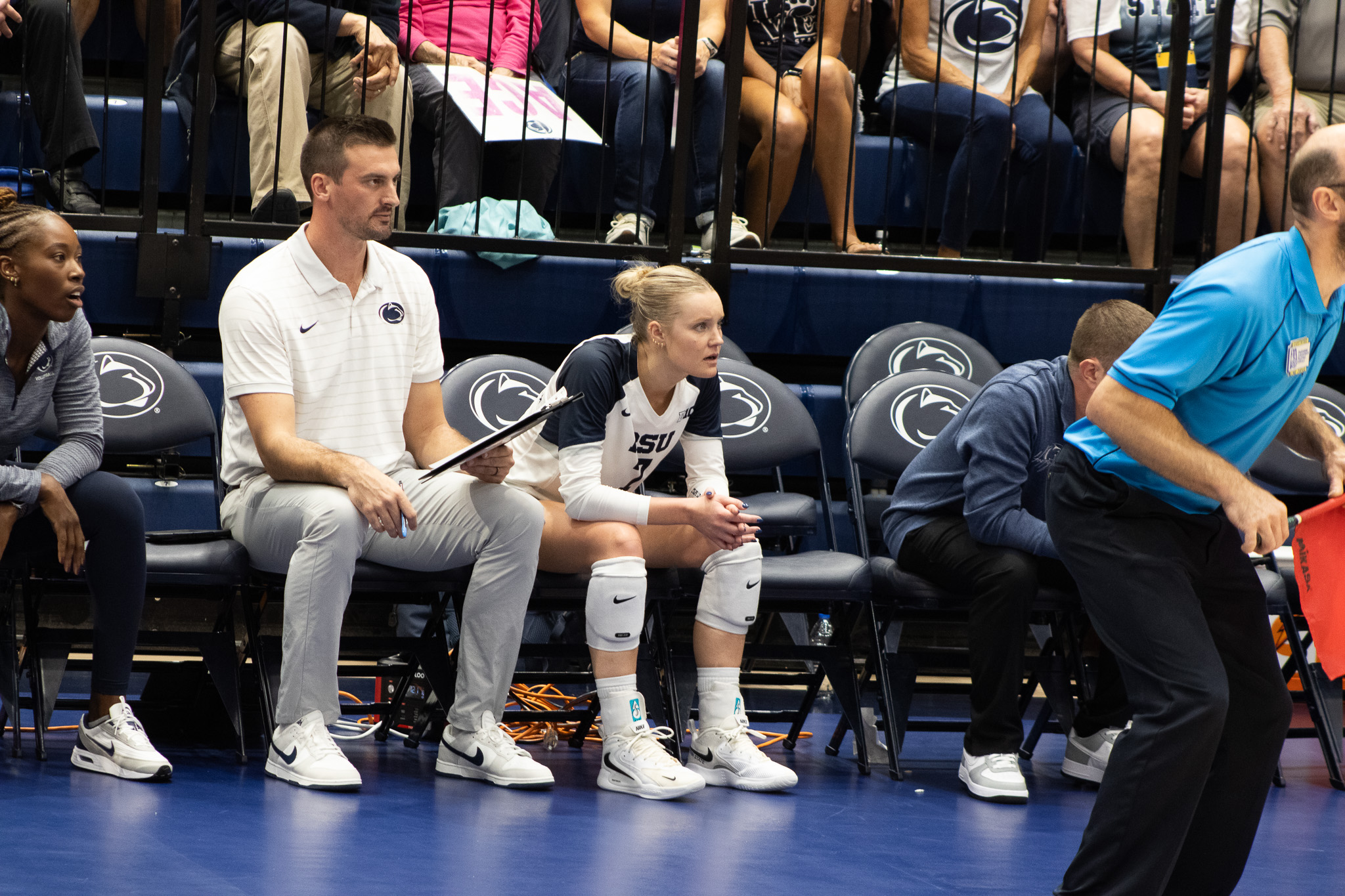
Assistant Coach Mike Henchy sat down with DigNittany’s Ethan Kasales for an extended interview on November 25, 2025. The following is a transcript of the conversation, lightly edited for length and clarity:
Experience at Penn State to Date
Ethan Kasales: What has your experience been like at Penn State so far working with the different assistant coaches and the athletes?
Mike Henchy: Coming in, it was excitement to join such a strong program, one that’s had so much success. There’s energy to that, that you bring in, you want to be able to come in and make an impact. And I came into a very good squad, and was fortunate, and came into really good relationships as well. Staff wise, we were able to connect pretty quickly, and I think we saw the game in similar ways, but still find ways to help the team grow in different areas.
And so obviously, year one went extremely well. We got to start off with the foreign trip, which I think was really valuable, because the players, the staff, everybody, got to know my family during that time as well. I can’t really say enough good things about how we’re operating as a staff and how we’re able to work together. It’s nice. I don’t take that for granted at all. Anywhere that I’ve been it has been a goal to make sure that the staff works well together, because if that isn’t the case, things can get pretty sticky. But for us, despite getting a new director of ops, new strength coach, everybody’s been able to come in and contribute and work well together, which is great.
The girls work hard, so there’s not oftentimes you’re stressing about what they’re going to bring, but all of that, I mean, makes for such a good experience. Like, the joy for me in coaching is coaching. When we’re in the gym and they’re listening and they’re giving you all that they can give on any particular day, it’s a good day.
So I’ve had a really good time. I’ve enjoyed every bit of it. I mean, seasons are long and they’re tiring, but that’s normal, whether you’re winning or losing. The payoff has been everything that I could hope for in terms of experience and being able to grow and learn here.
Introduction to Volleyball
Ethan Kasales: How were you introduced to volleyball?
Mike Henchy: My mom played in high school. My grandpa did a little bit of JV coaching, not much. So, I was around it, but I didn’t play much — just gym class through middle school. Then I knew I was going to try out my freshman year of high school, because pretty much every school in California has a boys’ team. I said, “I’ll play football in the fall, and then that’ll be my spring sport, so I don’t have to do PE or off season conditioning.” And I found some early success as a middle and enjoyed just playing. And that kind of fostered me to go find a camp, eventually switch positions to have more of an impact on the game, just stay on the court longer, and followed it that way. So really, I think just my mom playing and kind of encouraging me to try, and my being six-five or almost six-six as a freshman also helps, just comparatively to the kids that I was playing against. So I think early success drove some of the enjoyment, as well as just liking the sport. But no real special entry. Just gave it a try and liked it.
How He Chose Ohio State for College
Ethan Kasales: How did you find your way to Ohio State, and what was your experience like playing there?
Mike Henchy: That was actually almost dumb luck. Only one of the three coaches on Ohio State’s staff ever saw me play live before I got an offer. I was in the midst my junior year, switching from a middle to an outside, and I would get to play a handful of sets every once in a while as an outside. But for the most part, our club team needed me in the middle, and so the one coach from Ohio State saw me play as a pin, and went and grabbed the head coach, who came back and watched me. I was back in the middle the next set, so he got to watch me play and move a little bit. But I didn’t have film. I think there were some of the people my age that were starting to take film and send it out, and I didn’t.
I had emailed the top 15 schools. So, Penn State was on that list, butI think there was a lot of uncertainty around me. I was big and moved okay, but I wasn’t super quick. There were enough other good pins — I mean, Aaron Russell was in my class — so there were enough good pins that you didn’t really have to take a risk or gamble on me. Ohio State was one of the two teams that, at least at the conclusion of my junior club year, were willing to say, “hey, we’ll let you play on the outside.” And that’s really what I wanted to do. So I took my visit, got to do the whole football game thing, met [Ohio State head football coach] Jim Tressel, met the AD, Archie Griffin — -really cool things that I probably didn’t fully appreciate. I did really appreciate, at the time, the Jim Tressel conversation, because it was 20 minutes of his day, the day before a football game. And I was pretty much sold.
After that, I went on one more visit to UC San Diego, — it was kind of a courtesy visit. My mom made me take it. But I knew going into that where I was going to be playing. I got some interest after that from some other schools, once I was fully playing as an outside the next season, but I had already committed. I was pretty dead set on Ohio State.
How His Recruitment has Informed His Recruiting as a Coach
Ethan Kasales: How has going through the recruiting process as a player yourself informed you as a coach now that you are recruiting prospects?
Mike Henchy: I’m more tolerant of the unprepared ones, the ones that don’t know exactly what we’re looking for, what we need, information wise, and so I’m more willing to tell to recruits that I need more information or the type of things that we would need. I’d say recruiting at Penn State’s a little different than some of my other stops, in that our pool is smaller and most of those players have pretty good guidance from club directors and coaches that know what we need and help them get there. But it’s definitely been maybe a soft spot for me at camps or other things. When people ask recruiting questions, I’ll sit down and I’ll have a phone call after camp and say “Hey, here are the things you need to do.” Make sure that they know it’s on their plate. If there are things that they want to happen, it’s up to them to drive that. I probably could have been stronger at that going through my process. And so, I think it’s just helping them learn what it actually looks like, as opposed to writing off those that don’t already know what they need to know.
How He Got into Coaching
Ethan Kasales: How did you get into coaching, or first decide that you wanted to do that?
Mike Henchy: When I finished playing, it really was like the spark for playing had been taken away a bit, from both injury — it was a bad season — and then the coaching that I had there was really off-putting. There was no motivational coaching at all — it was all reactionary. There was a level of me that wanted to provide something different for other players. But I wasn’t totally set on coaching. I was thinking I would probably like to teach or coach. I had a marketing advertising degree, and I thought the information was fascinating from that, but it wasn’t, career wise, what I wanted to apply into the world and have my meaning to be around. Both my parents are high school teachers. My grandfather is a teacher. I have three aunts that are teachers. So to some degree it’s in my blood, it was in my upbringing. And I think there was “let’s maybe try teaching or coaching.” And I never got around to trying substitute teaching or doing anything in that world, because I started coaching, volunteering and working at a club, and just loved it. And was like, “This is it. That’s what I want to do.” Then I took that to the master’s program that I did in physical education, advanced level coaching. It’s a great program at Springfield College, and just kind of furthered my interest in all of the different ways that you can be a coach, mentally, motor learning, motivational. I learned how to scout from some really good, high-level coaches. It was somewhat of a natural fit that I didn’t forecast right out of college.
On Building a Life with his Wife and the Importance of Her Support
Ethan Kasales: You met your wife at Ohio State. What’s it been like building a family with her and having her support?
Mike Henchy: She knew what we were getting into with coaching before I did. By the time I was post-grad and making that decision, we had already been together three and a half, almost four years. To say she had some hesitation would be too strong of a word, but she was already mentally preparing herself, at 23, that okay, this is a big decision.
She’s been everything that you need to be able to succeed in [coaching], because she takes up the home life, the taking care of Calvin [their son] now, the stuff that I can’t do when we’re traveling for recruiting or for matches and does it without complaint. And I know it’s hard, but she understands that it’s not a real decision to be gone. It’s just part of the job, and doesn’t lay that on me, which is big. And then there’s times too, where I’m tired or beaten down, and she knows why we’re doing this. She knows that it’s to help young adults, men or women to find their way in, finding their confidence, finding some belief, staying true to the process of learning and growing, and will help me recenter on those things when maybe she hears some tone in my voice or some complaining. She really keeps me grounded to what we’re doing and why we’re here. It’s everything I think you need if you want to have a long career in this.
Ethan Kasales: She does some yoga teaching in town. Has she gotten you into that at all?
Mike Henchy: Totally. We did it together, actually. I was first to yoga, not the type of yoga we’re doing now, but I’d done it actually a few times in high school with my mom, and I got us to sign up our senior year in a one credit yoga class. And we did that together. When we moved away from Columbus, we joined a yoga studio together. That was her pushing it, and we both have loved it. We’ve done it everywhere. We were doing it during Covid. She ended up getting her certification, really leaping in and learning a lot more about it. And she loves that. If there’s a passion for her, it is that teaching, and it is through yoga. I think we both have that little bit of teacher in us that wants to help others, and it’s been fun. I haven’t been going as much as I probably need to or could, but yeah, it’s something we definitely share together.
Ethan Kasales: How does yoga help center you and prepare you for your day?
Mike Henchy: I think there’s an element to it, especially with what we ask our players to do, of being able to push through hard things or discomfort and knowing that you’ve got more in the tank. The classes that you teach are tough, but you get the reward of one breaking through and being able to push through what your body is signaling you versus what it’s capable of, and then just the mindfulness of that practice is good as well, to maintain your focus on what you want versus all of the different distractions that beat in. It’s easy to let your mind wander, but that truly is a practice if you’re doing it correctly, where it is, a mind practice as well, of breath, intentional movement, being mentally where you are physically. I enjoy it a lot.
The Evolution of Volleyball in California
Ethan Kasales: What’s it been like seeing how California has evolved, as far as volleyball goes — a traditional power, and some really good players out there still.
Mike Henchy: Absolutely. I mean, there’s just the culture there. I would say the real disparity is on the men’s side, because of the high school involvement and the length of the high school involvement. Volleyball is growing on the boy’s side everywhere. But it just has such a long history in California that it’s really strong on the men’s side. On the women’s side, there are great players. Obviously, we have Finley Krystkowiak coming in [from California]. It seems every year there’s a player [from California] at that level that is of recruiting age. Again, the culture of it fits. You have those beach towns that have the sand volleyball as well, where they’re playing it year round. On the women’s side, the volleyball is so popular across the nation that [California] is a hotbed, but it’s not an outlier because you have Texas, you have Ohio, you have Louisville, you have Florida, you have a lot of different places where volleyball is really big and there’s a lot of good coaches.
Admiration for Assistant Coach Megan Hodge Easy
Ethan Kasales: What are some things you admire about Coach Megan?
Mike Henchy: She sees the game very well, obviously. With her experience, she knows the game’s intricacies and to a very high level. But again, she’s one that’s in this for the impact on the players and helping them grow, and we get to do it on the court. But her patience and her commitment to them through easy and tough times and what they’re getting out of this is probably the most enjoyable part, just working with her.
On Working Closely with Assistant Coach Brian Toran
Ethan Kasales: What’s relationship like with Brian?
Mike Henchy: Yeah, we hate each other [laughing]. No, we have a good banter. We work really closely on recruiting ideas, tactical stuff in match. I think we see things very similarly and divert in good ways where we can see the other’s perspective and might just have a difference of true opinion, not fact, in some areas that we can healthily go back and forth on. That’s been good for us because we do have our eyes open to, I think, our own blind spots. So we’re able to push and pull each other a little bit and find our ways to some successful results.
What He Likes Most About Working with Coach Katie
Ethan Kasales: What do you like most about working with Coach Katie?
Mike Henchy: I think just the way that she treats everybody. When you’re with her, she’s with you. That type of personality is infectious. Congenial is the word for it, really. She puts a lot of trust in us. She lets us operate in the way that’s natural to us. She gives us feedback and guidance when things may be, you know, not even wavering, but just “Hey, I want to make sure that this is the message,” and is able to help us see why that’s the message at certain times. That doesn’t happen too much. It’s more preemptive than reactive. But I really appreciate the autonomy to be able to scout the way I need to scout, or organize the way that I need to organize, and the trust from her that that’s going to bring the information that the team needs from me. She’s a good leader in the sense that she empowers us to work to our potential. She’s not having to drive us, and doesn’t feel the need to micromanage what we’re doing. She has a healthy lens of what we need to be doing, and checks in to make sure that we’re taking care of the things that need to be taken care of. She’s on top of it on her end but lets us do it the way that we need to.
How He Has Improved as a Coach Throughout His Career
Ethan Kasales: What are some things you think you’ve improved as a coach throughout your career so far?
Mike Henchy: A lot of it, I would say, is the translation of knowledge to teaching, which can be tough. And I think finding each individual player’s learning language. It kind of falls separate from what a lot of the literature would say, like “keep your stuff the same” in terms of what we call a certain shot. You always want to call it a certain shot, but I think for players, as they’re learning to apply, you need to find different pathways to help them understand what that language is. And it’s not always that they don’t fully understand, but there might be just a slight different interpretation that helps them perform what you’re asking a little bit better. So, you’re not actually changing your language, but you’re helping them see what that language really means. So that’s probably the thing that you just continue to refine and get better at through this. I’d say the other end is just operationally, how the job functions. It’s a lot more familiar. It’s a lot easier to just do those things, because it’s part of the routine that when you’re starting off, you just don’t know what you don’t know. And there’s a lot of back-end things that you’ve got to take care of, that you learn as you go along.
Rundown on the 2026 Recruiting Class
Ethan Kasales: Getting into the 2026 recruits, could give a rundown for all four of them? What are some of the strengths of their games that impress you?
Mike Henchy: I’ll go in order of when they committed.
Danielle Whitmire plays every skill of the game well. She can dig. She’s a great setter. She can attack. She has a really, really nice arm. She’s a tactical server. Her blocking is pretty intuitive, like she knows where to put her hands to have an effect on the play, whether or not it’s stuffing the ball or just trying to get a hitter to do something uncomfortable. Setting wise, she’s got a very natural touch. Her hands are very flowy, but she can push the ball the full length. So she can do a lot of things athletically that you can’t teach. It’ll be maybe refining just some of those movements to help her excel beyond that.
Finley Krystkowiak is a physical athlete — she’s a Big 10 player, for sure. Just how she’s built, she competes, she’s able to turn on another level in matches that matter more. And I think having that gear is important because you just need it. And she’ll need it more often here in college than she’s had to in her career. But I think having that ability, and having seen it, she’s an exciting player. Again, she can play six-rotation. She’s good passer, heavy arm. She’s one that I think will grow into a role pretty quickly, just through her willingness to compete and learn, as well as having a good frame to build off of.
Haley Burgdorf is another Big 10 player. She’s not as tall as Finley, but she jumps well, has a really live arm, very scrappy defensively. She’s able to move well laterally. So she’s got a lot of intangibles that you’re looking for. I think the thing that she’s had, and I think just from watching and talking to others, she has such a motor for learning and training and wanting to get better, and that’s going to push her really far. She’s already in a really good spot with how she plays volleyball. She’ll have some adaptations, as everybody does, to collegiate volleyball, but she’s going to be the one that’s driving her own growth because of just how she approaches wanting to get better, which is really exciting.
Kendall Northern is lightning quick. There were so many times watching club where I thought she got beat by a set, and nope, she was there by the time she needed to be there. And so having quickness in the middle spot is really important to be able to close. And she’s also quick off the ground and has a quick arm. So I think she has things that you can’t train, that’ll be able to be an asset in the gym. As well as the experiences for her to have continued to grow, even since we recruited her. She was, I think, two years back in the United States — she had been living in Switzerland — and was getting her feet under her as far as the game at a high level. And we’ve seen that grow across, as she able to play in the Under Armor All Star game. And so she’s gotten recognition for that growth and that jump as well. But again, she’s so quick, and that’s just something you really can’t train terribly well. You’re either super quick or you’re not. Anybody can get a little faster, but it’s something that she definitely will bring to the table, that people will enjoy watching and be surprised about, I think, the first time they watch her play.
With all four of them, I think they’re coming in, they’ve connected well, they’ve got some energy about being a Penn Stater and being able to come here and build on the legacy that already exists.
Ethan Kasales: What are some ways that Kendall is able to play above her height?
Mike Henchy: She’s quick off the floor. That’s always helpful, regardless of how high you end up. If you can be quick off the floor, you can beat some people just with tempo. In the middle, you can put a faster tempo, and she’s going to be there. I don’t recall her last touch, but she’s probably like, 10’ 6” or so. I’m ballparking there, but I feel like that was a number that I heard. She’s not big, but she’s quick off the floor, and she does get up high. So she’s going to be someone that maybe is similar to a Taylor Trammell in terms of quickness and ability to close. Some might look at her and say she’s undersized for a middle, but it’s not going to affect her impact on the game because of her quickness.
Some of the Things Kennedy Martin Does Best
Ethan Kasales: In your opinion, what are some of the things that Kennedy Martin does best?
Mike Henchy: It’s kind of a soft skill – it’s the learning component. She wants to build on the areas that she doesn’t feel as comfortable with and she is comfortable dealing with that uncomfortableness. To have that “growth and learn” mindset is something that can be hard to teach. It’s the goal across the board to get people in that mindset. But she has it. The way that she’s been able to develop and get better as a blocker and defender this year – things that she wanted to do and put effort toward – and we’ve seen that growth. This past weekend, I think she averaged a block per set.
Obviously, her attacking is her home base. That’s where she’s had success, where she feels comfortable. But even with that, the growth mindset piece of what she can do with her arm and her size, that she may be isn’t tapped fully into, but she’s open to it. And she dives into those areas. So I think that’s her number one asset. Obviously, being big in volleyball helps. Having a good arm in volleyball helps. Her successes kind of speak for themselves on the attacking side. But what’s going to be the determining factor for her moving forward is that growth mindset.
What Has Impressed Him About Addie Lyon
Ethan Kasales: What’s impressed you about Addie Lyon and the way she’s performed this year?
Mike Henchy: I think she’d say the same thing: This isn’t what she expected out of this year. And I think there’s a excitement at first of “oh, here’s this opportunity now,” and then there’s a weight to that as well – playing in so many competitive matches, games that matter, in an environment and home, in a way that you haven’t seen through your career, that requires you to kind of go back to the learning and figuring out, okay, how do I be successful in this environment? And I think we’ve ridden that roller coaster, and she’s to a spot now where she understands Big 10 volleyball, she understands timing and matches it, and what she’s got to do, distribute the ball to be able to help us succeed, as well as even as a blocker. She’s found a way to be impactful for us, and that’s been a growth for her through the season. She was a back row setter only and didn’t serve at times for her team, and so her role not only is elevated in terms of conference, but it’s elevated in terms of skills that she’s been asked to do. And I think all of that requires such a concentrated effort that she’s weathered extremely well. And she’s done it so poised that looking at her through matches, you never would have known if she’s stressed or feels uncomfortable, because she holds herself well. And that’s important as a setter, to be able to hold a steady demeanor for your teammates.
Thoughts on Gillian Grimes Being Drafted by San Diego
Ethan Kasales: What are your thoughts on Gillian Grimes being drafted yesterday by San Diego?
Mike Henchy: Exciting. I think it’s a culmination of her career here, and she’s been such a steady presence for the back court, and has been able to elevate her game in matches that matter most for us. So I think it was something we expected. Weren’t sure necessarily when it would be or who would be, but I think she’ll be able to have a pretty successful pro career for as long as she wants to chase that dream and be good. She’s been so natural in serve-receive and defensively she can make some high level plays and some large range. So I think for us, it was just an exciting recognition of things that we knew about her already, which is great.
Ethan Kasales: She’s played in every match for Katie since she took over as head coach. What does that speak to about her resiliency and ability to stay on the court and tough it out?
Mike Henchy: I mean, the number one thing is staying healthy. They have less impact as a backcourt player, but it still is a task to be available for that many matches as well as have the impact that she has throughout four years. There are not many people that will have that on their resume in terms of how many games they’ve played, how many games they’ve started. That’d be an interesting thing. I don’t know the stat of Penn Staters where, pretty much match-in, match-out, she’s having some sort of impact on the game. It’s really impressive, and it’s really impressive to do it here at Penn State.
Improvement of the Outside Hitters This Season
Ethan Kasales: We’ve seen the outsides improve and become a little bit more consistent this year.
Mike Henchy: Yeah, Lexi Ewing has done a lot to catch up to college, and a lot has passed to her but she’s jumped in and shouldered it well, CJ has really been able to embrace playing on the left and find success as an attacker, as a blocker, passing for sure, that we knew was there, we’d seen her do it, But it was a matter of the time to build the comfortability in it that is there, which is great to see. And then with Emmi, I think again, it was kind of a factor of that continued growth. She had a Big 10 season at Ohio State prior to coming here, but not a full season, and not one where maybe the [scouting was as focused on her]. So, her ability to find her way and weather through some of the difficulties of just being a priority on people’s scout sheet. Her passing has been unbelievable as of the last four or five matches, which is something we need, I think any team needs to be successful. And then she’s been able to slowly transform her attacking range to create some more kills and be successful.
Getting All Seven Grads into the Starting Lineup Against Maryland on Senior Day
Ethan Kasales: You guys were able to get all seven grads into the starting lineup. What was that like on senior day?
Mike Henchy: I hope it was as special for them as we hoped it would be, just to have their name called in Rec Hall, have their video up on the board, be able to toss stuff to the crowd, their parents, their family. It was great that we were able to work that out and give them all that moment, as well as play some points. And I mean, all of them earned some form of a point for us, which was also just that you hope for, but you can’t guarantee. It was great to see.
Ethan Kasales: Awesome. Thank you so much, safe travels.